The Life and Legacy of Amalia Hernandez
- Get link
- X
- Other Apps
The Life and Legacy of Amalia Hernandez
Introduction
I chose Amalia Hernández because I think she’s really cool and inspiring. What I liked most about her is how she mixed classical ballet with traditional Mexican folk dance to create something totally new and different. I think it’s awesome how she used dance to tell stories and share Mexican culture with people all over the world. Her group, Ballet Folklórico de México, helped show how beautiful and important these traditions are. I picked her because she made a big impact and showed that art can be a powerful way to connect with others and share where you come from.
You can see how confident she is in the way she holds herself, which really draws your attention. And if you look at what she’s wearing, that high-neck top with the bold pattern, it’s not just a costume. It feels meaningful, probably tied to the dance she was performing that day. It reminds us that what she was doing wasn’t just a "dance," it was storytelling through her body.
At the top, she’s fully in character, dressed in traditional costume, lost in the emotion of the performance. Below, those close-up shots show her grace and strength off stage, too. There’s a quiet power and pride in her expression that tells you just how passionate she was about her art and her culture.
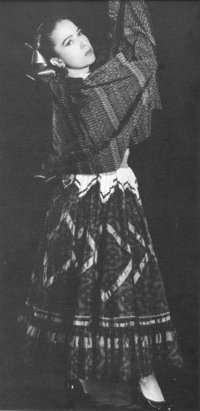
In this photo, you can really see her embodying the spirit of traditional Mexican dance. From the flowing skirt to the way she holds the rebozo, everything about her posture is elegant, but also full of emotion.
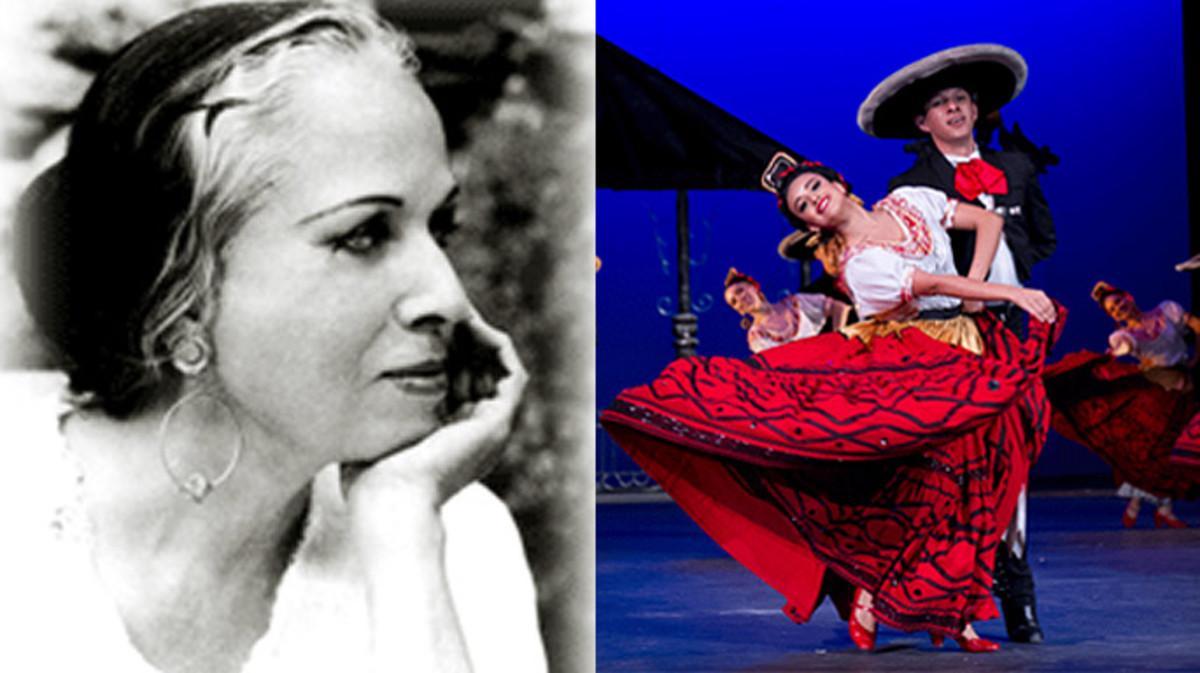
On the right, there's a folkloric dance performance showcasing traditional Mexican attire. The composition seems designed to make it look like Hernández is proudly watching the legacy she created come to life on stage through the Ballet Folklórico de México.
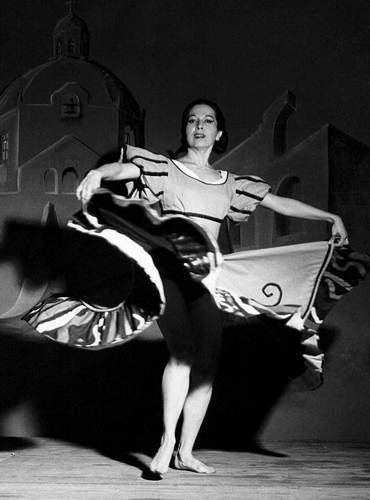
Amalia is elegant and powerful, dancing with bare feet on the wooden stage, emphasizing the authenticity of traditional Mexican dance.
The video shows folkloric performances that highlight the diverse traditions of Mexico, reflecting Hernández's vision of preserving and celebrating Mexican culture through dance.
Hernández’s choreographic innovations continue to influence modern dancers and choreographers, with her pieces like Los Hijos del Sol and La Danza del Venado remaining staples in the world of folk ballet (Garcia 88). Even after her passing in 2000, the Ballet Folklórico de México continues to honor her legacy by performing her works, preserving the fusion of classical ballet and Mexican traditions she pioneered (Ballet Folklórico de México). Hernández’s contributions to education, through the establishment of the Ballet Folklórico School in Mexico City in 1969, ensure that future generations of dancers can continue to explore and innovate within her unique dance fusion (Garcia 77). Her enduring legacy as a cultural ambassador and visionary in the world of ballet cements her place as one of the most influential figures in dance history.
This gala not only commemorates six decades of folkloric dances founded by Amalia Hernández but also serves as a testament to Amalia Hernández's vision of bringing Mexican traditions to the global stage.
Founded by Hernández in 1952, the Ballet Folklórico de México was her visionary project to preserve and celebrate the diverse cultural traditions of Mexico through dance. The performances in the video show her commitment to bringing these traditions to the stage, blending authentic music, and dynamic choreography.
References
Ali, A. N. M. A. (2024). Developing an efficient regulatory framework for safe street food in Bangladesh: Lessons from comparative analyses. [Manuscript in preparation or publisher if known].
AP News. (2016, June 28). Mexican schools have 6 months to ban junk food sales or face heavy fines. https://apnews.com/article/mexico-schools-junk-food-ban-sheinbaum-1ac32132a00b7d22ac8e99d3bf647375
Ballet Folklórico de México de Amalia Hernández
Ballet Folklórico de México de Amalia Hernández. (2013, October 28). Ballet Folklórico de México de Amalia Hernández [Video]. YouTube. https://www.youtube.com/watch?v=93WeXpntWO0
Ballet Folklórico de México de Amalia Hernández
Ballet Folklórico de México de Amalia Hernández. (2014, September 15). Ballet Folklórico de México de Amalia Hernández [Video]. YouTube. https://www.youtube.com/watch?v=51WAFv03go4
El Periódico. (2017, 19 de septiembre). Amalia Hernández. El Periódico. https://www.elperiodico.com/es/extra/20170919/amalia-hernandez-6295139
Gala 60 Años Ballet Folklórico de México de Amalia Hernández
Ballet Folklórico de México de Amalia Hernández. (2012, September 17). Gala 60 Años Ballet Folklórico de México de Amalia Hernández [Video]. YouTube. https://www.youtube.com/watch?v=45KAm_pUEFE
Gutiérrez-Pliego, L. E., Camarillo-Romero, E. D. S., Montenegro-Morales, L. P., & Garduño-García, J. D. J. (2016). Dietary patterns associated with body mass index (BMI) and lifestyle in Mexican adolescents. BMC Public Health, 16, Article 1. https://doi.org/10.1186/s12889-016-3259-7
Gutiérrez Tolentino, R., Lazarevich, I., Gómez Martínez, M. A., Barriguete Meléndez, J. A., Schettino Bermúdez, B., Pérez González, J. J., del Muro Delgado, R., & Radilla Vázquez, C. C. (2024). Epidemiological overview of overweight and obesity related to eating habits, physical activity, and the concurrent presence of depression and anxiety in adolescents from high schools in Mexico City: A cross-sectional study. Healthcare, 12(6), Article 604. https://doi.org/10.3390/healthcare12060604
Hernández, A. (2024, mayo 22). Amalia Hernández, ícono de la danza y la cultura de México. Clarín. https://www.clarin.com/sociedad/amalia-hernandez-icono-danza-cultura-mexico_0_ry74diaqW.html
Las Crónicas de mi Patria. (2017, 19 de septiembre). Amalia Hernández Navarro (1917–2000): Bailarina y coreógrafa mexicana. Facebook. https://www.facebook.com/LasCronicasDeMiPatria/posts/amalia-hern%C3%A1ndez-navarro-1917-2000-fue-una-bailarina-y-core%C3%B3grafa-mexicana-nacid/1919399054966136/
Office of Disease Prevention and Health Promotion (OASH). (2025). Food insecurity. U.S. Department of Health and Human Services. https://odphp.health.gov/healthypeople/priority-areas/social-determinants-health/literature-summaries/food-insecurity
Rodríguez, L. A., Mundo-Rosas, V., Méndez-Gómez-Humarán, I., Pérez-Escamilla, R., & Shamah-Levy, T. (2017). Dietary quality and household food insecurity among Mexican children and adolescents. Maternal & Child Nutrition, 13(4), e12372. https://doi.org/10.1111/mcn.12372
Secretaría de Cultura. (2011, 4 de noviembre). Amalia Hernández: símbolo de la mexicanidad. https://www.cultura.gob.mx/noticias/efemerides/16831-amalia-hernandez:-simbolo-de-la-mexicanidad.html
Siekmans, K., Fracassi, P., Kato, T., Seow, T. K., Carter, D., Horton, S., ... & Shibata Okamura, K. (2024, April). Understanding the links between diet quality, malnutrition, and economic costs. International Food Policy Research Institute. https://doi.org/10.2499/p15738coll2.136764
Soleri, D., Cleveland, D. A., Aragón Cuevas, F., Jimenez, V., & Wang, M. C. (2023). Traditional foods, globalization, migration, and public and planetary health: The case of tejate, a maize and cacao beverage in Oaxacalifornia. Challenges, 14(1), 9. https://doi.org/10.3390/challe14010009
Sweis, N. (2023). Beyond “Eat less and move more”: A multidimensional economic analysis of the obesity problem. [Manuscript in preparation or institutional report].
Zárate-Ortiz, A. G., Melse-Boonstra, A., Rodríguez-Ramírez, S., Hernández-Cordero, S., & Feskens, E. J. (2019). Dietary patterns and the double burden of malnutrition in Mexican adolescents: Results from ENSANUT-2006. Nutrients, 11(11), Article 2753. https://doi.org/10.3390/nu11112753
- Get link
- X
- Other Apps
Comments
Post a Comment